
DRA says algorithmic control is the next battle for the gig economy…. do you agree??
Drivers Representation & Advocacy (DRA) says the €825 million
($966 million) fine imposed on Uber by the Dutch Data Protection Authority should be a warning to the entire gig economy, companies cannot use algorithms to make life-changing decisions about workers and then hide behind the technology when things go wrong.
The Dutch regulator found serious infringements relating to Uber’s use of automated systems to suspend and deactivate drivers. Uber has disputed the findings and said it intends to appeal.
But DRA says the significance of the decision goes far beyond Uber.
The real question is simple: who is responsible when an algorithm decides whether someone is allowed to work?
For thousands of gig-economy workers, an app is not simply an app. It is their workplace, their source of income and, in many cases, the only way they can earn a living.
If an algorithm can decide that a driver should be suspended, deactivated, paid less or offered different work, then that algorithm is exercising real power over that worker’s life.
DRA believes that power must come with transparency, accountability and a genuine right to challenge decisions.
 The algorithm cannot be the judge, jury and executioner:
For years, drivers have warned about the growing use of automated systems to monitor their work and make decisions about their accounts.
A driver can spend years building up a good rating and completing thousands of journeys, only to find themselves suddenly locked out of the platform following an automated decision or complaint.
Once the account disappears, so does the income.
The driver is then expected to prove their innocence while the company controls the information needed to understand how the decision was made.
Yaseen Aslam, Founder of Drivers Representation & Advocacy and lead claimant in the landmark Uber BV v Aslam Supreme Court case, said:
“This is much bigger than an €825 million fine. This is about who is actually in control of people’s working lives.
For years, drivers have been told that they are independent, that they are simply using an app and that the platform is only a marketplace. Yet that same platform can monitor you, decide what work you are offered, determine what you are paid, control your access to customers and potentially decide whether you can work at all.
“You cannot exercise that level of control and then blame the algorithm when something goes wrong. An algorithm does not write itself. People design it, companies choose how to use it and companies must take responsibility for the consequences.
“I’ve been organising drivers since 2014 and I’ve watched this industry become increasingly dependent on technology that drivers cannot see into and cannot challenge. The technology may have changed, but the power imbalance has not.”
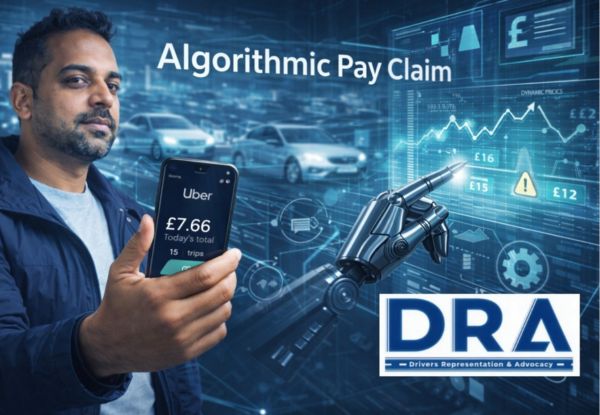
From robo-firing to algorithmic pay:
DRA says the Dutch decision also raises wider questions about how algorithms are being used to determine driver earnings and access to work.
Uber’s move from traditional fixed fares towards Dynamic (Upfront) Pricing has changed the relationship between drivers and the platform.
Many drivers report that earnings have become harder to predict and that there is little transparency over how fares are calculated, how trips are allocated and what data is being used to influence those decisions.
DRA believes algorithmic management does not stop at deactivation.
It can affect what a driver is offered, what a passenger pays, what the driver receives, where the driver is sent and ultimately whether the driver can make a sustainable living.
The organisation is therefore preparing a collective legal challenge involving UK drivers over algorithmic management, driver data and Uber’s approach to driver pay.
DRA is working with PersonalData.io and the French organisation Force Ouvrière INV as it develops its legal strategy.
The French drivers who refused to accept the system:
DRA has been working closely with Paul-Olivier Dehaye, data scientist and founder of PersonalData.io, together with driver organisations and campaigners in France.
The complaints brought by French drivers were instrumental in bringing Uber’s automated decision-making practices to the attention of the Dutch regulator.
Their work demonstrates the importance of drivers challenging decisions that would otherwise remain hidden inside the platform.
DRA believes the Dutch decision could become an important milestone in the wider fight over algorithmic management across the gig economy.
What happened in the Netherlands could have implications far beyond Uber and far beyond the Netherlands.
Who owns the driver’s data?
DRA is also raising concerns about the enormous amount of information now collected about gig-economy workers.
Trips, earnings, locations, working patterns, acceptance rates, cancellations, customer ratings and other information can create an extraordinarily detailed picture of a driver’s working life.
Yet drivers often have little understanding of how that information is being used to make decisions about them.
Yaseen Aslam said:
“Driver data has become one of the most valuable assets in the gig economy, but the driver is often the last person to know what is being done with it.
“Companies can use data to build increasingly sophisticated systems that manage drivers, predict their behaviour and influence what they earn. The driver is expected to accept the decision without being allowed to see how it was reached.
“That cannot be the future of work. If you are going to make decisions about someone’s livelihood using their data, that person has a right to understand what is happening and a genuine opportunity to challenge it.”
DRA: drivers must not become the raw material for the algorithm:
DRA says it is also taking a different approach to driver data.
The organisation does not want to build a campaign around collecting as much driver information as possible. Where data is required for legal action, DRA says it will only be used with the driver’s explicit consent and for the specific purpose for which it has been provided.
Aslam said:
“We don’t want drivers to move from one system where their data is being exploited into another system where they don’t know what is happening to it.
“If we ask a driver for their data, they should know why we need it, what we intend to do with it and who will have access to it. That’s basic transparency.
“Our fight is not simply against one company. It is about the future of work. We have to make sure technology works for people rather than people becoming raw material for technology.”
The gig economy is at a crossroads:
DRA believes the Dutch decision comes at a critical time for the gig economy.
Platforms are increasingly using artificial intelligence, automated decision-making and data-driven systems to manage workers on a scale that would have been impossible only a few years ago.
The technology is developing rapidly.
The rules protecting workers have not kept pace.
DRA says governments and regulators now face a choice: allow algorithms to quietly take over decisions traditionally made by employers, or establish clear rules requiring transparency, human accountability and meaningful rights for workers.
Yaseen Aslam said:
“We have already seen what happens when governments wait until technology has moved ten steps ahead of the law.
“Drivers cannot wait another ten years for politicians to understand what is happening. By then, the algorithm will be making even more decisions about their working lives.
“The gig economy is at a crossroads. This is not just about Uber drivers. It is about what work looks like when companies can manage thousands of people through software without ever having to sit across the table from them.
“The algorithm cannot be above the law, and the driver cannot be left without a voice.”
UK drivers can register their interest:
DRA is continuing to invite UK drivers to register their interest in the proposed legal action.
Drivers who have experienced account suspension or deactivation, concerns over algorithmic decisions, changes to driver pay, Dynamic Pricing or the use of their personal data can register their interest with DRA.
Register your interest:
DRA will provide further information to registered drivers as the legal strategy develops.
